Refinance Risk in 2026: Why Investors Need a Backup Capital Plan
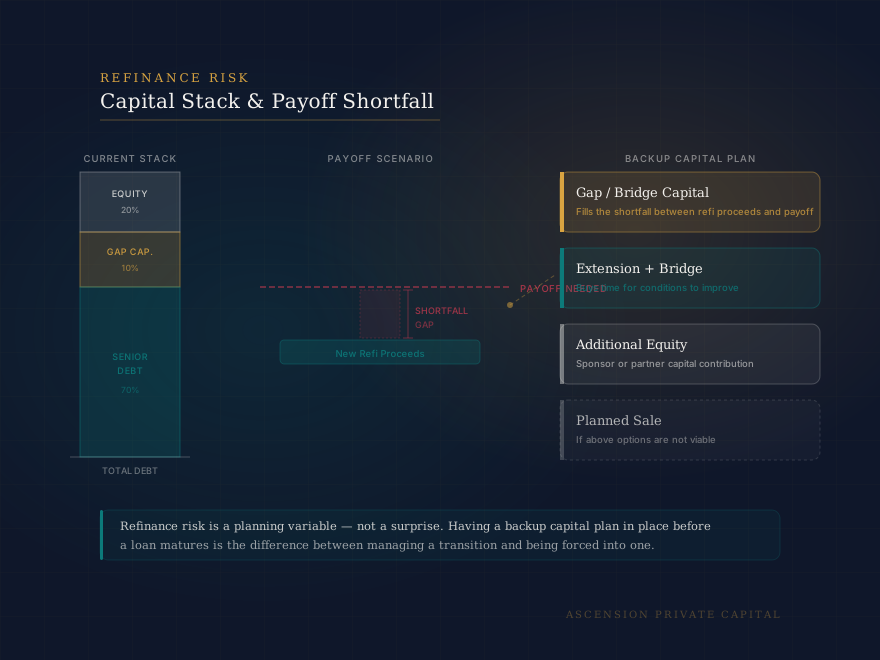
Refinance risk is a planning variable that every investor with short-term or maturing debt should account for. Having a backup capital plan is the difference between managing a transition and being forced into one.
01
What Refinance Risk Means
Refinance risk is the risk that a borrower will be unable to refinance a loan on acceptable terms when the time comes to transition from one financing structure to another. It applies to any situation where a loan maturity, rate reset, or planned refinance event creates a deadline that requires new capital.
Refinance risk is distinct from default risk. An investor can be current on all payments, have a performing asset, and still face refinance risk if the available refinance products at the time of maturity do not support the outstanding loan balance or the investor's capital needs.
The risk exists on a spectrum. At one end, refinance is available but on less favorable terms than originally anticipated. At the other end, no refinance is available at all, and the investor faces the consequences described in What Happens When a Real Estate Loan Matures and You Can't Refinance.
02
Why Refinance Risk Matters in 2026
A significant volume of short-term real estate debt originated in 2022-2024 is approaching maturity in 2025 and 2026. Many of these loans were originated under different rate assumptions, valuation expectations, and market conditions than what exists today.
For investors holding this debt, refinance risk is elevated because:
- Refinance products may require higher debt service coverage ratios at current rates
- Property valuations may not have appreciated as originally projected
- Lease-up or stabilization timelines may have extended beyond original business plan assumptions
- Capital partners may have adjusted leverage thresholds or reserve requirements
- Some property types face reduced capital availability compared to prior years
None of this means refinance is impossible. It means that investors who assumed the refinance would be straightforward need to validate that assumption and have a plan in case reality looks different from the original projection.
03
What Can Affect Refinance Options
Multiple variables can affect whether a refinance is available, what size it can be, and on what terms. Understanding these variables helps investors identify which ones apply to their deal and whether any are trending in a direction that creates risk.
Rate Environment
Higher rates reduce the loan amount that a given NOI can support. A property that could support a $2M refinance at one rate may only support $1.7M at a higher rate, creating a payoff shortfall.
Property Valuation
Refinance LTV limits are applied against the appraised value at the time of refinance. If the value has not grown as projected, or has declined, the maximum loan amount shrinks.
Net Operating Income
For commercial and multifamily, NOI drives debt service coverage. If expenses have risen, rents have not grown as projected, or occupancy is below target, the DSCR may fall below the lender threshold.
Occupancy and Lease Status
Refinance lenders want stabilized occupancy. Vacant units, month-to-month leases, or pending tenant turnover can affect whether a DSCR or commercial lender will approve the refinance.
Property Condition
Deferred maintenance, incomplete renovations, or structural issues identified during the appraisal can result in repair escrows, reduced valuations, or outright declines.
Sponsor Liquidity
Refinance lenders require post-closing reserves. If the investor's cash was consumed during the bridge hold by renovation costs, carry expenses, or unexpected repairs, meeting reserve requirements may be difficult.
04
Why Backup Capital Plans Should Be Created Before Maturity
A backup capital plan is not an admission that the primary exit will fail. It is a recognition that real estate investing involves variables that cannot be perfectly predicted, and that having an alternative path prepared is a professional risk management practice.
The backup plan should be created 6-12 months before the maturity date, well before any pressure exists. At that point, the investor has time to:
- Honestly assess whether the primary refinance is on track
- Identify specific obstacles that could prevent the primary exit from closing
- Research and document 2-3 alternative capital paths that are viable for the deal
- Pre-qualify those alternatives by understanding the documentation and timeline requirements
- Begin assembling documentation that would support a pivot if needed
- Maintain relationships with capital partners who could serve as backup options
Investors who create backup plans early retain leverage, negotiating power, and options. Those who wait until the final weeks before maturity are negotiating from weakness, and the market knows it. For a deeper look at what happens under time pressure, see Loan Maturity Risk in 2026.
05
Possible Backup Capital Paths
The right backup path depends on the deal, the property type, and why the primary refinance may not work. Common alternatives include:
New Bridge Financing
A new bridge loan can pay off the maturing loan and provide additional time for stabilization. Viable when the property has equity and a credible path to permanent financing within the new term.
Gap or Shortfall Capital
When the refinance is available but falls short of the payoff amount, subordinate or gap capital can bridge the difference. This allows the refinance to close without requiring the investor to inject large amounts of cash.
Recapitalization or Partner Equity
Bringing in a capital partner, co-investor, or equity source can provide the funds needed to reduce the senior debt balance to a level that the refinance lender can support.
Sale of the Asset
A planned, orderly sale is always preferable to a forced sale. If the primary refinance is unlikely to work and no viable alternative exists, an early decision to sell preserves more value than waiting until default pressure forces the transaction.
Extension of the Current Loan
If extension options exist or can be negotiated, they provide time, though typically at a cost (fees, paydowns, rate increases). Extensions are a bridge strategy, not a solution in themselves.
DSCR or Commercial Refinance With Adjusted Terms
Sometimes the primary lender is not viable but an alternative lender with different criteria can provide the refinance. Shopping the deal to multiple capital partners increases the odds of finding a workable solution.
06
Warning Signs That the Primary Refinance May Not Work
Refinance problems rarely arrive without warning. Investors who monitor their deals actively can identify these signals early enough to pivot:
- Property NOI or rental income has not reached the level assumed in the original business plan
- Occupancy remains below the threshold required by the intended refinance lender
- Renovation or improvements are incomplete or over budget
- Market comparables suggest the appraised value may come in lower than needed
- The borrower's personal liquidity or credit has deteriorated during the hold period
- The intended refinance product has changed its terms, criteria, or availability
- The loan is within 6 months of maturity and no refinance application has been submitted
Any single warning sign is manageable if addressed early. Multiple warning signs appearing together, or any warning sign appearing within 90 days of maturity, should trigger immediate activation of the backup capital plan. The cost of acting early is almost always lower than the cost of acting late. See Bridge Loan Maturity: Exit Planning for more on managing timeline pressure.
07
How APC Helps Investors Review Scenarios and Evaluate Capital Paths
Ascension Private Capital works with investors who are evaluating refinance risk and need to understand their options before pressure builds. Our role is to help investors see clearly where they stand and what paths are realistically available.
That process typically includes:
- Reviewing the current loan terms, maturity timeline, and extension options
- Assessing the property's current performance against refinance lender requirements
- Identifying the gap (if any) between what the refinance can provide and what is needed
- Evaluating alternative capital paths: bridge, gap, sale, extension, or recapitalization
- Helping investors prioritize the most viable options based on deal-specific variables
- Preparing documentation and positioning for the chosen path
All financing is subject to capital partner approval, terms, conditions, and underwriting requirements. APC helps investors navigate the process. We do not control the outcome. But investors who approach these situations with clear information, realistic expectations, and prepared documentation produce significantly better results than those who wait and hope.
08
Key Principles for Managing Refinance Risk
- Refinance risk is a planning variable. Treat it as part of the deal structure from origination, not as a future emergency.
- The backup capital plan should exist before the maturity date approaches, not in response to a decline.
- Monitor property performance and market conditions continuously, not just at origination and maturity.
- Start active refinance preparation 6-12 months before maturity. This is the professional standard.
- Multiple viable exit paths provide leverage. A single path with no alternative creates vulnerability.
- Acting early when warning signs appear preserves options. Waiting eliminates them.
- A well-positioned deal with clear documentation and realistic projections attracts better capital solutions.
Need a Backup Capital Plan Before Your Refinance Window Closes?
Submit your scenario and we will review the current position, evaluate available capital paths, and help you prepare a plan before time pressure builds.
Submit a Funding RequestRelated Insights
Continue exploring practical capital strategy, lender expectations, and funding structure insights.
Loan Maturity Risk in 2026: What Real Estate Investors Need to Know
What loan maturity risk means for investors in 2026 and how to plan before the deadline arrives.
What Happens When a Real Estate Loan Matures and You Can't Refinance?
When a loan matures without a clear refinance path, investors face limited and often costly options.
Bridge Loan Maturity: How Investors Can Plan the Exit Before the Deadline
Bridge loans have finite terms. How to plan the exit strategy well before the maturity date arrives.
Plan Before the Pressure Builds
The best time to build a backup capital plan is before you need one. Submit your scenario and let us help you evaluate the options while time is still on your side.
Submit a Funding Request