What Happens When a Real Estate Loan Matures and You Can't Refinance?
When a loan reaches its maturity date and the borrower has no clear path to repay the balance, the situation moves quickly from inconvenient to urgent. Understanding the possible outcomes helps investors avoid the worst of them.
01
What Happens at Loan Maturity
When a real estate loan reaches its maturity date, the full outstanding principal balance becomes due. This is not a suggestion or a soft deadline. It is a contractual obligation. The borrower must repay the loan in full through refinance, sale proceeds, or cash on hand.
If the borrower cannot satisfy this obligation, the loan enters a state of default. The specific consequences depend on the loan documents, the lender, and the jurisdiction, but the general trajectory is the same: the lender begins exercising remedies to protect their position.
For investors who have built their business plan around a refinance exit, a failed refinance at maturity creates a cascading set of problems that become harder to solve with each passing day.
02
Why Inability to Refinance Creates Pressure
The inability to refinance is not just a financial inconvenience. It fundamentally changes the investor's leverage in every subsequent negotiation. Once a loan is past maturity:
- The lender has contractual rights to pursue default remedies
- Default interest rates (often significantly higher than the contract rate) may begin accruing
- The investor's negotiating position weakens with each day past maturity
- Other capital partners are less willing to participate in a deal that is already in distress
- The investor's reputation with capital partners and brokers may be affected
- Legal costs begin accumulating on both sides
The pressure compounds because time is no longer on the investor's side. Every option (refinance, sale, extension, recapitalization) takes time to execute. When that time has already expired, the remaining paths narrow significantly.
03
Extension Negotiations
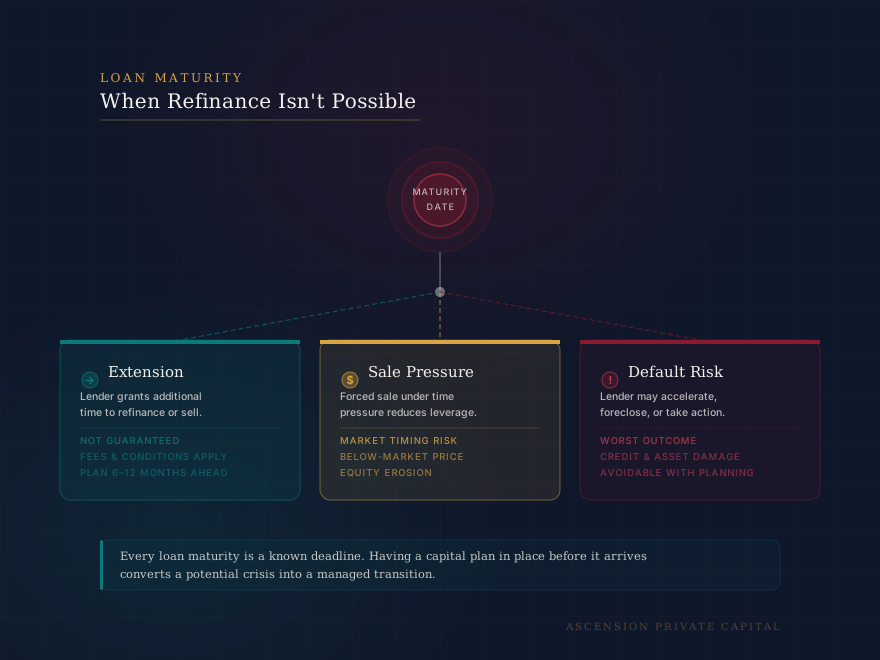
The first option most investors explore when they cannot refinance at maturity is a loan extension from the existing lender. Extensions are common in real estate lending, but they are not guaranteed and they are not free.
What lenders typically require for an extension:
- An extension fee (often a percentage of the outstanding loan balance)
- A principal paydown to reduce the lender's exposure
- Updated property financials showing the asset's current performance
- A credible plan for how the borrower will exit within the extension period
- Evidence that the borrower has liquidity to continue servicing the debt
- In some cases, additional collateral or guarantor support
Not every lender will grant an extension. Some loan structures do not allow for extensions beyond a certain point. And even when an extension is available, it may buy time without solving the underlying problem, particularly if the asset's performance is the reason the refinance failed in the first place.
04
Sale Pressure
When refinance is unavailable and an extension is either denied or insufficient, the investor may face pressure to sell the property. In theory, a sale is always an option. In practice, a forced or time-pressured sale often results in a discounted price.
Buyers who recognize that a seller is under maturity pressure will typically offer below market value. The seller's negotiating leverage is limited because the alternative (foreclosure or continued default) is worse than accepting a discount.
For investors who have spent significant capital on renovations, lease-up, or repositioning, a distressed sale can mean losing the value they have created in the asset. The improvements are captured by the buyer at a discount rather than by the seller at full value.
05
Rescue Capital and Bridge Options
In some cases, investors facing maturity pressure can source rescue or bridge capital to pay off the maturing loan and buy additional time. This path is viable when the asset has value and a credible plan exists, but the timing of the original exit simply did not work out.
Bridge financing in this context serves as a replacement for the maturing loan, providing a new short-term capital structure while the investor completes stabilization, improves occupancy, or waits for market conditions to support a permanent refinance.
However, bridge capital for maturing loans is not the same as standard acquisition bridge financing. Capital partners evaluating these scenarios will scrutinize why the original exit failed and whether the new business plan is realistic. The cost of capital may be higher, and leverage may be more conservative. Having equity remaining in the deal and a clear path to the next exit is critical for this option to be viable.
06
Gap or Shortfall Scenarios
Sometimes the refinance is partially available but does not cover the full payoff. For example, an investor may have a $2M loan balance maturing, but the refinance lender will only provide $1.7M based on current property performance or valuation. The $300K gap must be solved for the refinance to close.
These shortfall scenarios are common when property values have not appreciated as projected, when NOI is below the level needed for full refinance sizing, or when the refinance lender requires reserves that consume the available capital.
Options for covering a refinance shortfall may include gap funding, borrower equity injection, mezzanine or subordinate capital, or restructuring the deal to reduce the required payoff. Not every shortfall can be solved, but many can be addressed with advance planning and realistic assessment of the capital structure. For more on shortfall scenarios, see When Senior Debt Comes Up Short.
07
Risks of Waiting Too Long
The single most damaging pattern in loan maturity risk is delay. Investors who wait until 30-60 days before maturity to begin addressing the exit face a drastically reduced set of options:
- Most refinance lenders cannot close within 30 days, even on clean files
- Bridge lenders evaluating distressed timing scenarios price in additional risk
- Extension negotiations require time and back-and-forth that may exceed the remaining window
- Sale processes require marketing time, due diligence, and closing coordination
- Legal counsel and advisors need time to evaluate and negotiate terms
- The investor's emotional state and decision-making quality decline under time pressure
The practical window for addressing a maturity event is 6-12 months before the due date. Within that window, investors have time to evaluate options, prepare documentation, approach capital partners, and execute a transition. After that window closes, the options become progressively more expensive and less favorable. See Loan Maturity Risk in 2026 for a full breakdown of planning timelines.
08
How Investors Can Prepare Before Maturity
Avoiding the worst maturity outcomes is largely a function of planning and honest assessment. Investors who proactively manage their exit timeline give themselves the most options and the best negotiating position.
Preparation steps that make a meaningful difference:
- Know your maturity date and mark 6, 9, and 12-month milestones before it
- Track property performance monthly: NOI, occupancy, rent collection, expenses
- Model the refinance at current conditions, not just the original projections
- Identify gaps between current performance and lender requirements early
- Build and maintain relationships with capital partners before you need them urgently
- Prepare documentation packages proactively, not reactively
- Have at least one backup exit path identified and partially prepared
Ascension Private Capital helps investors evaluate maturing loan scenarios and identify realistic next steps. Whether the path forward is a refinance, a bridge replacement, a sale, or a restructuring, early assessment creates better outcomes. All financing paths are subject to capital partner approval and underwriting requirements.
Need to Review a Maturing Loan Scenario?
Submit your scenario and we will assess the capital position, evaluate available exit paths, and help determine realistic options based on the property, the timeline, and the current loan structure.
Submit a Funding RequestRelated Insights
Continue exploring practical capital strategy, lender expectations, and funding structure insights.
Loan Maturity Risk in 2026: What Real Estate Investors Need to Know
What loan maturity risk means for investors in 2026 and how to plan before the deadline arrives.
Bridge Loan Maturity: How Investors Can Plan the Exit Before the Deadline
Bridge loans have finite terms. How to plan the exit strategy well before the maturity date arrives.
When Senior Debt Comes Up Short
How to think through cash-to-close gaps, rehab shortfalls, and lender proceeds that come in lower than expected.
Do Not Wait for the Deadline
The earlier you start planning, the more paths remain available. Submit your scenario and let us help evaluate your position.
Submit a Funding Request