Loan Maturity Risk in 2026: What Real Estate Investors Need to Know
Every loan has a maturity date. When that date arrives and the borrower cannot refinance, sell, or pay off the balance, the consequences can be severe. Understanding maturity risk early gives investors time to plan and protect their position.
01
What Loan Maturity Risk Means
Loan maturity risk is the risk that a borrower will be unable to refinance, sell, or otherwise pay off a loan balance when the loan term expires. It is not a theoretical concern. It is a structural reality of short-term and medium-term real estate debt.
Bridge loans, construction loans, and many commercial financing products have defined terms (typically 12 to 36 months for bridge capital, and 5 to 10 years for many commercial products). When those terms end, the full outstanding balance becomes due. If the borrower cannot satisfy that obligation, the lender has contractual remedies that can include default interest, foreclosure, or forced sale.
Maturity risk is not about whether an investor wants to refinance. It is about whether the investor can refinance, and whether the conditions that existed when the loan was originated still exist when the loan comes due.
02
Why 2026 Matters for Investors With Short-Term Debt
Many real estate investors who took on short-term bridge or construction debt in 2023 and 2024 are approaching maturity dates in 2025 and 2026. The capital environment those loans were originated in may look different from the environment in which they are maturing.
Factors that may have shifted since origination include:
- Cost of capital and prevailing interest rates
- Lender risk appetite and credit availability
- Property valuations and cap rates in specific markets
- Occupancy and lease-up timelines that took longer than projected
- Renovation or construction timelines that extended beyond original estimates
- Borrower liquidity that was depleted during the hold period
None of these shifts guarantee that a refinance will fail. But they mean that the assumptions built into the original deal plan (specifically, the exit assumptions) should be re-evaluated well before the maturity date arrives.
03
Why Refinance Conditions Can Change Before a Loan Matures
When a bridge loan or short-term commercial loan is originated, the exit strategy is usually based on projected conditions: a property that will be stabilized, a renovation that will be complete, a lease-up that will have reached a target occupancy, or a market that will have appreciated.
Those projections do not always materialize on schedule. And even when the property executes as planned, the capital markets available for the takeout refinance may have shifted. A deal that would have easily qualified for a permanent refinance in one environment may face tighter qualifying criteria, lower valuations, or higher rate assumptions in another.
This mismatch between what was projected at origination and what is available at maturity is the core of loan maturity risk. It is not a failure of execution. It is a timing and market variable that needs to be actively managed.
04
What Affects Refinance Options at Maturity
Capital partners evaluating a refinance request at or near maturity focus on the same fundamentals as any other financing request, but with heightened attention to why the borrower needs to refinance now and whether the asset can support the requested debt.
Net Operating Income (NOI)
The property must generate enough net income to meet the refinance lender's debt service coverage requirements. If NOI has not reached the projected level, the refinance loan amount may be smaller than needed.
Occupancy and Lease Stability
Refinance lenders want stabilized occupancy with tenants in place. If lease-up is still in progress or if major tenants have short remaining terms, the refinance may be harder to place.
Property Valuation
The appraised value at the time of refinance drives the LTV calculation. If values have not appreciated as projected (or have declined), the maximum loan amount shrinks and the borrower may need to bring capital to close.
Sponsor Liquidity
Refinance lenders evaluate post-closing reserves. If the borrower's liquidity was consumed during the bridge hold (by construction overruns, extended carry costs, or unexpected expenses), meeting reserve requirements becomes challenging.
Each of these variables should be monitored continuously during the bridge or short-term hold, not just evaluated at origination and again at maturity. Investors who track these metrics quarterly are better positioned to identify problems early and adjust course.
05
Why Investors Should Not Wait Until the Maturity Date
One of the most common and most costly mistakes in managing loan maturity risk is waiting too long to start the refinance or exit process. Investors sometimes assume they will figure it out when the time comes, or that the lender will simply extend the loan.
In practice, extensions are not guaranteed. They may come with significant fees, higher rates, additional reserve requirements, or paydown obligations. Some lenders will not extend at all if the asset has not performed as originally underwritten.
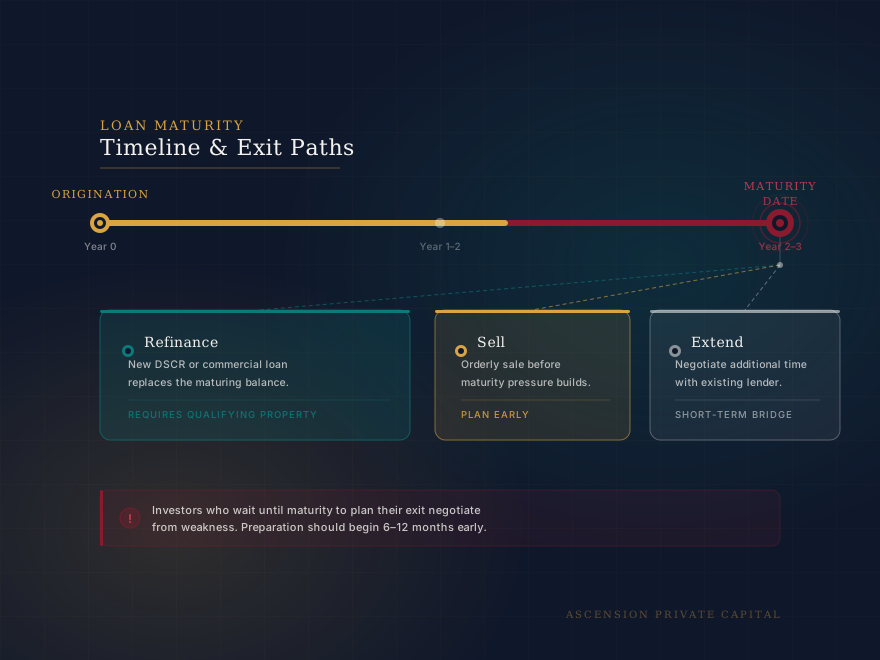
Starting the refinance evaluation process 6 to 12 months before maturity gives investors time to:
- Assess whether the asset qualifies for the intended takeout financing
- Identify any gaps between current performance and lender requirements
- Explore alternative capital paths if the primary exit is not viable
- Negotiate extension terms with the current lender if needed
- Source bridge or gap capital to cover shortfalls before they become emergencies
- Prepare the documentation package required for a new financing application
Waiting until the final 60-90 days before maturity eliminates most options. At that point, the investor is negotiating from a position of weakness, and available capital solutions are likely more expensive and less favorable than they would have been with earlier planning.
06
Backup Capital Planning
A backup capital plan is a structured set of alternative paths an investor can pursue if their primary exit strategy does not materialize. It is not a sign of weakness. It is a sign of professional deal management.
For investors approaching loan maturity, backup capital planning may include:
- Identifying alternative refinance lenders with different qualifying criteria
- Evaluating whether a new bridge loan can provide additional time for stabilization
- Assessing whether gap or subordinate capital can solve a paydown shortfall
- Determining whether a partial sale, recapitalization, or JV can provide the needed capital
- Modeling extension terms and whether they create a viable path to the permanent exit
- Preparing for a sale if refinance is not achievable within the remaining timeline
The goal is not to predict failure. The goal is to have multiple viable paths documented and partially prepared so that if the primary exit encounters an obstacle, the investor can pivot quickly without losing the asset or facing distressed terms. For more on how bridge loans create maturity pressure and how to plan exits, see Bridge Loan Maturity: How Investors Can Plan the Exit Before the Deadline.
07
How APC Helps Investors Navigate Maturity Risk
Ascension Private Capital works with investors who are approaching loan maturity and need to evaluate their options. Our role is to review the current capital position, assess the asset's readiness for refinance, and help identify realistic next steps.
That process typically includes:
- Reviewing the current loan terms, maturity date, and extension options
- Assessing the property's current performance relative to refinance requirements
- Identifying whether the deal qualifies for DSCR, commercial, or bridge takeout capital
- Evaluating the capital stack for gaps or shortfalls that need to be addressed
- Helping investors prepare documentation for the refinance or alternative exit
- Sourcing capital partner options based on the specific scenario
APC does not guarantee refinance outcomes or lender approvals. All financing is subject to capital partner evaluation, terms, conditions, and underwriting requirements. Our role is to help investors understand their position, identify available paths, and prepare for the best possible outcome given the deal variables. For more context on what happens when refinance is not available, see What Happens When a Real Estate Loan Matures and You Can't Refinance.
08
Key Takeaways for 2026
- Loan maturity risk is structural, not speculative. Every short-term loan has a hard deadline.
- Refinance conditions can change between origination and maturity. Do not assume the exit will look the same.
- NOI, occupancy, valuation, and borrower liquidity all affect whether the exit is viable.
- Start evaluating exit options 6-12 months before the maturity date.
- Backup capital planning is not pessimism. It is professional deal management.
- Extensions are not guaranteed and often come with meaningful cost.
- The earlier you identify a problem, the more options you have to solve it.
Facing a Loan Maturity or Refinance Deadline?
Submit your scenario for review. We will assess the current capital position, evaluate available exit paths, and help determine realistic next steps based on the deal variables.
Submit a Funding RequestRelated Insights
Continue exploring practical capital strategy, lender expectations, and funding structure insights.
Bridge Loan Maturity: How Investors Can Plan the Exit Before the Deadline
Bridge loans have finite terms. How to plan the exit strategy well before the maturity date arrives.
What Happens When a Real Estate Loan Matures and You Can't Refinance?
When a loan matures without a clear refinance path, investors face limited and often costly options.
Refinance Risk in 2026: Why Investors Need a Backup Capital Plan
What refinance risk is, what causes it, and how having a backup capital plan protects deals when primary refinance paths close.
Plan Your Exit Before Time Runs Out
The best time to address maturity risk is before it becomes a crisis. Submit your scenario and let us help you evaluate the options.
Submit a Funding Request