Multifamily Financing in 2026: Why Capital Structure Matters More Than Ever
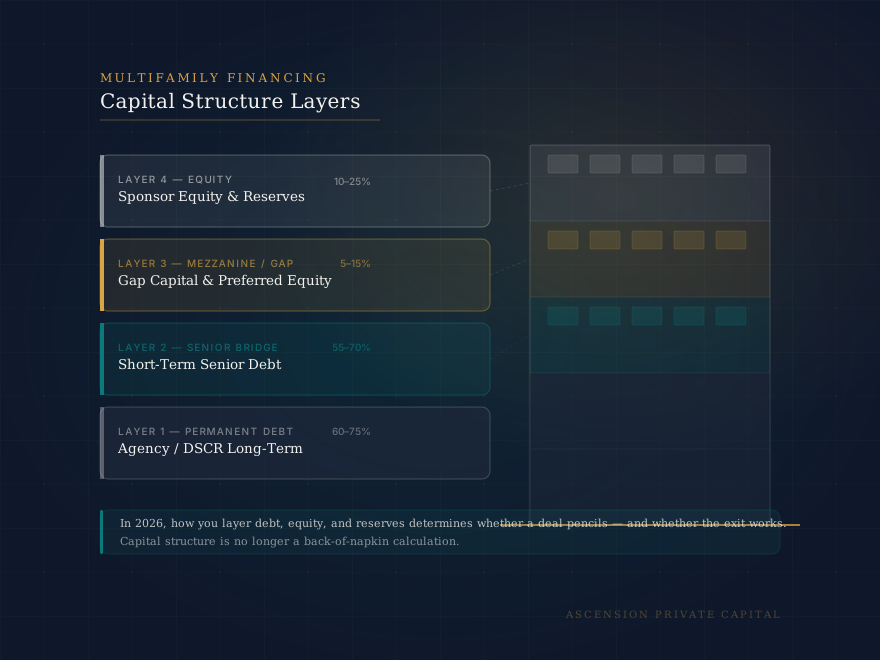
For multifamily investors, the capital structure decision is no longer a back-of-napkin calculation. In 2026, how you layer debt, equity, and reserves determines whether a deal pencils, whether it closes, and whether the exit works when the time comes.
01
Why Multifamily Is More Sensitive to Capital Structure
For a single-family rental financed with a DSCR loan, the capital structure is relatively simple: a down payment, a loan at a certain LTV, and monthly rent that covers the debt service. The variables are limited and the margins for error are wider.
Multifamily assets (particularly those with 5 or more units, value-add components, or repositioning plans) involve a capital structure with significantly more moving parts. The total capital required often includes:
- Senior debt (bridge or permanent) sized against the property's income and value
- Equity contribution from the sponsor or investor group
- Capital improvement or renovation budget
- Operating reserves for carrying costs during transition or lease-up
- Interest reserves if the property is not yet generating sufficient cash flow
- Potential gap or subordinate capital if senior proceeds fall short of total project cost
Each layer of the capital stack interacts with the others. Over-leveraging the senior debt can eliminate the reserve cushion. Under-budgeting the renovation can leave the property unstabilized when the bridge term expires. Getting the structure wrong at the outset creates problems that compound throughout the hold period.
02
What Affects Financing Outcomes in 2026
Capital partners evaluating multifamily deals in 2026 are focused on a set of fundamentals that have always mattered, with increased scrutiny on whether the deal can perform as underwritten given current conditions.
Debt Sizing and NOI
Loan amounts are driven by net operating income and debt service coverage thresholds. If actual NOI is lower than projected, loan sizing shrinks and the equity gap widens.
Occupancy and Rent Stability
Stabilized occupancy with tenants on executed leases demonstrates reliable income. Properties still in lease-up or with significant vacancy face tighter terms and lower leverage.
Reserves and Liquidity
Capital partners want to see that the sponsor has liquidity beyond what is needed to close. Post-closing reserves protect against vacancy, maintenance, and unexpected carrying costs.
Sponsor Experience
Capital partners want sponsors who have managed comparable assets. First-time multifamily investors may face more conservative leverage, higher reserve requirements, or co-sponsor expectations.
These variables are interconnected. A deal with strong NOI but a weak sponsor may get conservative terms. A deal with a strong sponsor but low occupancy may require bridge capital with a stabilization timeline. Understanding how each variable affects the outcome helps investors structure deals that capital partners can support.
03
Bridge Debt vs. Permanent Financing for Multifamily
One of the most consequential capital structure decisions for multifamily investors is whether the deal requires bridge capital or can support permanent financing from day one.
Bridge capital makes sense when:
- The property requires renovation or capital improvements before it can achieve stabilized income
- Occupancy is below the threshold required for permanent financing
- The business plan involves a lease-up period that will take 6-18 months
- The property is being repositioned (e.g., converting unit mix, upgrading amenities, improving management)
- The investor intends to refinance into permanent debt after stabilization
Permanent financing (agency loans, CMBS, bank products, or life company capital) is appropriate when:
- The property is already stabilized with consistent income and high occupancy
- NOI supports the debt service at current rates without relying on future rent growth
- The investor intends to hold long-term without a near-term value-add plan
- The property's condition does not require significant capital expenditure
Choosing bridge capital when permanent is available means paying a higher cost of capital unnecessarily. Choosing permanent when the asset is not ready means the application will likely be declined or the terms will be unfavorable. The right answer depends on where the asset is today, not where the investor hopes it will be.
04
Why Exit Strategy Matters Before Closing
For any multifamily deal financed with bridge or transitional capital, the exit strategy must be defined and validated before the loan closes. The exit is a present-day underwriting variable that affects every aspect of the capital structure.
A realistic exit plan answers these questions:
- What is the intended takeout? (Permanent refinance, sale, or recapitalization)
- What property performance metrics must be achieved for the takeout to work?
- What is the realistic timeline from acquisition to stabilization?
- What happens if stabilization takes longer than projected?
- Is there a backup exit if the primary path encounters an obstacle?
- Does the bridge loan term provide adequate time for the business plan plus a buffer?
Capital partners underwriting bridge loans for multifamily evaluate the exit as part of the approval decision. A deal with a strong entry but an unrealistic exit is a maturity risk waiting to happen. For a deeper look at exit planning, see Loan Maturity Risk in 2026.
05
How Refinance Risk and Maturity Risk Affect Multifamily Investors
Multifamily investors using bridge or short-term commercial debt face a specific form of risk: the possibility that the planned refinance exit from the bridge loan may not be available on the terms or timeline originally assumed.
This risk is amplified by factors that are partially or entirely outside the investor's control:
- Interest rate movements that affect debt service coverage calculations
- Valuation shifts that reduce appraised values and maximum loan amounts
- Lease-up timelines that take longer than projected due to market conditions
- Renovation delays or cost overruns that extend the stabilization timeline
- Capital partner risk appetite changes that affect available products or terms
None of these risks mean a deal should not be pursued. They mean the capital structure should account for them. Building buffer time into bridge terms, maintaining adequate reserves, and identifying backup exits are all structural decisions that protect against refinance risk. Investors who ignore these variables and assume everything will go as planned are the most vulnerable when conditions shift.
06
When Multifamily Investors Need Different Capital Types
Not every multifamily deal fits neatly into a single capital product. Many scenarios require staged capital, multiple layers, or a transition from one product to another over time. Common multifamily capital needs include:
Acquisition Bridge Capital
Short-term financing to acquire a multifamily asset that is not yet stabilized. Used when the property needs renovation, lease-up, or operational improvement before it qualifies for permanent debt.
Repositioning and Value-Add Capital
Financing that includes renovation or capital improvement budgets. Typically structured as a bridge loan with a draw schedule tied to construction milestones.
Construction Capital
Ground-up multifamily construction financing. Requires detailed plans, permits, a construction timeline, contractor documentation, and a clear path to lease-up or sale upon completion.
Bridge-to-Permanent Strategy
A planned two-step approach where bridge capital funds the acquisition and stabilization, followed by a refinance into permanent commercial or agency debt once the asset performs.
Understanding which capital type fits the deal (and whether a single product or a staged approach is needed) is the starting point for a sound capital structure. Approaching a capital partner with the wrong ask wastes time and can damage credibility for future submissions.
07
How APC Helps Investors Think Through the Capital Stack
Ascension Private Capital works with multifamily investors to evaluate and structure the capital stack before approaching capital partners. This pre-positioning work helps ensure that the deal is presented correctly, to the right type of capital partner, with the right documentation and narrative.
That process includes:
- Evaluating the property's current and projected performance against capital partner requirements
- Determining whether bridge, permanent, or staged capital is the right fit
- Identifying gaps in the capital stack and assessing realistic ways to address them
- Reviewing the exit strategy and its feasibility within the proposed loan term
- Helping investors prepare the documentation package required for a strong submission
- Matching the deal to capital partners whose criteria align with the specific scenario
APC does not guarantee approvals, terms, or financing outcomes. All capital is subject to partner evaluation and underwriting. Our role is to help investors understand their position, structure the approach correctly, and avoid the common mistakes that lead to declined submissions, unfavorable terms, or maturity problems. For documentation preparation, see Commercial Loan Document Checklist for 2026.
08
Key Takeaways for Multifamily Investors in 2026
- Capital structure determines whether the deal works across the full hold period, not just whether the loan closes.
- Multifamily deals involve more layers than residential DSCR: senior debt, equity, reserves, renovation budgets, and potentially subordinate capital.
- Bridge vs. permanent is dictated by where the asset is in its lifecycle, not personal preference.
- Exit strategy must be defined and validated before the bridge loan closes, not figured out later.
- Refinance risk and maturity risk are planning variables, not afterthoughts.
- The right capital partner depends on the specific deal type, timeline, and complexity.
- Pre-positioning the deal before approaching capital partners produces better outcomes.
Have a Multifamily Deal That Needs the Right Capital Structure?
Submit your scenario and we will evaluate the deal, assess the capital stack, and help determine the best approach based on asset performance, timeline, and exit strategy.
Submit a Funding RequestRelated Insights
Continue exploring practical capital strategy, lender expectations, and funding structure insights.
Commercial Real Estate Financing in 2026: What Investors Should Prepare For
How commercial real estate financing is being evaluated in 2026: underwriting shifts, capital stack considerations, and deal positioning.
Commercial Loan Document Checklist for 2026: What Investors Should Prepare
Documents investors should have ready before approaching capital partners for commercial or multifamily financing.
Loan Maturity Risk in 2026: What Real Estate Investors Need to Know
What loan maturity risk means for investors in 2026 and how to plan before the deadline arrives.
Structure the Deal Before You Approach Capital
The best multifamily outcomes start with the right capital structure. Submit your deal and let us help you build the right approach.
Submit a Funding Request