Commercial Real Estate Financing in 2026: What Investors Should Prepare For
The commercial financing landscape continues to evolve. Investors who understand what capital partners are evaluating — and how to position deals before submission — are better prepared to navigate the process and secure the right capital structure.
01
Commercial Underwriting Is More Asset-Driven
Unlike residential investor loans — where a borrower's credit, income, or debt service coverage ratio drives much of the approval — commercial real estate financing is evaluated primarily through the lens of the asset itself. The property's ability to generate stable, predictable cash flow is the foundation of the underwriting decision.
Capital partners financing commercial and multifamily assets typically evaluate net operating income (NOI), operating expense ratios, occupancy stability, lease quality, and the physical condition of the property. Borrower strength still matters — particularly the sponsor's experience and liquidity — but the asset is the primary security for the loan.
Investors transitioning from 1–4 unit DSCR loan strategies into commercial territory should expect a different evaluation framework. The documentation is deeper, the review process may take longer, and the conversation is less about qualifying the borrower and more about proving the deal.
02
What Capital Partners Are Evaluating in 2026
The core underwriting variables for commercial and multifamily financing remain consistent, but how capital partners weigh those variables can shift based on market conditions, cost of capital, and risk appetite. In 2026, capital partners are generally focused on:
Property Cash Flow and NOI
Actual trailing income performance — not projections alone — is the starting point for most underwriting decisions. Capital partners want to see how the asset has performed, not just how it could perform.
Occupancy and Lease Stability
Stable, paying tenants with remaining lease term reduce risk. Vacancy risk, short-term leases, and tenant concentration are evaluated carefully in current market conditions.
Business Plan Clarity
Whether the deal is a stabilized hold, a value-add repositioning, or a bridge-to-refinance strategy, capital partners want to understand the plan — and whether the sponsor can execute it.
Sponsor Experience and Liquidity
Capital partners want sponsors who have executed similar deals. Liquidity after closing — not just enough to close — is increasingly scrutinized as a risk buffer.
None of these variables are new. But in 2026, the bar for documentation and deal preparation is higher. Capital partners are less likely to offer term sheets on incomplete files or vague business plans. Deals that arrive pre-positioned with clear financials, realistic projections, and strong sponsor credentials move faster.
03
Bridge Capital vs. Permanent Financing
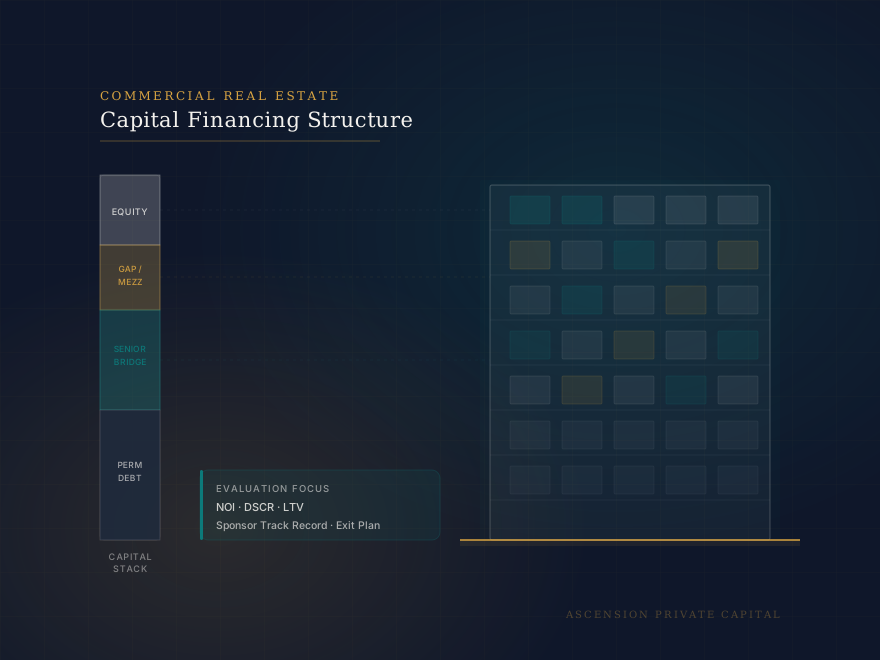
One of the most important capital structure decisions in commercial real estate is whether a deal requires short-term bridge capital, long-term permanent financing, or a staged approach that begins with one and transitions to the other.
Bridge financing is typically used for acquisitions that are not yet stabilized — value-add properties, repositioning plays, or lease-up scenarios where the asset needs time and capital before it can support permanent debt. Bridge terms are shorter, often 12–36 months, and the cost of capital is higher.
Permanent financing — agency loans, CMBS, bank financing, or life company capital — is available for stabilized assets with strong cash flow, good occupancy, and a clear operating history. These products offer longer terms and lower rates but require the asset to perform at or near stabilization.
Getting this decision wrong creates problems. Using short-term bridge capital without a realistic path to permanent refinance can lead to maturity risk. Conversely, trying to place permanent financing on an asset that is not yet stabilized wastes time and damages credibility with capital partners. The right capital structure starts with an honest assessment of where the asset is today and where it needs to be before permanent financing becomes viable.
04
Exit Strategy Is Not Optional
Every commercial financing request needs a clear, realistic exit strategy. For permanent financing, the exit is straightforward — hold and service the debt. For bridge, construction, and transitional capital, the exit must be defined before the capital is deployed.
Capital partners will ask: how does the investor intend to repay this loan? The answer needs to be specific, supported by the numbers, and achievable within the loan term. Common exits include:
- Refinance into permanent financing after stabilization
- Sale of the asset at a projected value supported by comparables
- Recapitalization with a longer-term capital partner
- Cash-out refinance once NOI supports higher leverage
Investors who cannot articulate their exit clearly will face more questions, tighter terms, or outright declines. In 2026, where refinance conditions are not guaranteed, capital partners are paying closer attention to whether the exit is realistic — not just possible in theory.
05
Why Capital Structure Matters Before Submission
Many investors approach capital partners before they have thought through their full capital structure. They know they need financing, but they have not worked through the layering — how much senior debt the property can support, whether gap or mezzanine capital is needed, what the equity contribution looks like, and whether reserves are adequate.
Capital structure questions that should be answered before submission include:
- What is the realistic senior loan amount based on the property's current performance?
- Is there a shortfall between senior proceeds and total project cost?
- What is the borrower equity contribution?
- Are there reserve requirements that need to be funded at closing?
- Does the deal need subordinate capital, and if so, what is the source?
- What is the total cost of capital across all layers of the stack?
Working through these questions before approaching capital partners produces better conversations, faster term sheets, and fewer surprises during underwriting. It also prevents the common problem of discovering a capital gap late in the process when time pressure makes it harder to solve.
06
How APC Helps Investors Position Commercial Deals
Ascension Private Capital works with investors on commercial and multifamily financing scenarios before they go to capital partners. Our role is to review the deal, identify the right capital structure, and help position the scenario for the best available financing outcome.
That process typically includes:
- Reviewing the deal summary, financials, and business plan for completeness
- Identifying whether the deal fits bridge, permanent, or staged capital
- Evaluating sponsor profile and experience relative to the deal complexity
- Assessing exit strategy feasibility based on the proposed timeline
- Determining which capital partners are most likely to be a fit for the specific scenario
- Helping investors assemble the documentation needed for a strong first submission
APC works across multiple U.S. markets, including Texas and New Jersey. All financing is subject to capital partner approval, terms, conditions, and underwriting requirements.
07
Preparing for 2026: Key Takeaways
- Commercial financing is asset-driven — prove the deal, not just the borrower.
- Capital partners expect complete documentation up front. Incomplete files slow everything down.
- Know whether your deal needs bridge, permanent, or staged capital before approaching anyone.
- Exit strategy must be specific, supported by numbers, and achievable within the loan term.
- Work through capital structure before submission — gaps discovered late create expensive problems.
- Sponsor experience and post-closing liquidity are evaluated more carefully than in prior years.
- Positioning a deal before it reaches capital partners improves speed, terms, and outcomes.
Have a Commercial or Multifamily Scenario to Discuss?
Submit your deal for a preliminary review. We will assess the scenario, identify the right capital structure, and determine next steps based on the property, the business plan, and available capital partner options.
Submit a Funding RequestRelated Insights
Continue exploring practical capital strategy, lender expectations, and funding structure insights.
Commercial Loan Document Checklist for 2026: What Investors Should Prepare
Documents investors should have ready before approaching capital partners for commercial or multifamily financing.
Multifamily Financing in 2026: Why Capital Structure Matters More Than Ever
Capital structure decisions have become more consequential for multifamily investors. How deal sizing, bridge vs. permanent debt, and exit planning affect outcomes.
How Commercial and Multifamily Underwriting Differs From 1–4 Unit DSCR Loans
What changes when investors move from DSCR lending into commercial and multifamily financing.
Ready to Position Your Deal?
Strong deal positioning leads to better capital conversations. Submit your scenario and let us help you prepare for the right approach.
Submit a Funding Request