How Commercial and Multifamily Underwriting Differs From 1–4 Unit DSCR Loans
The jump from residential DSCR lending to commercial and multifamily financing is not just a matter of scale. The underwriting framework, documentation expectations, and capital partner evaluation process are fundamentally different.
01
How 1–4 Unit DSCR Underwriting Works
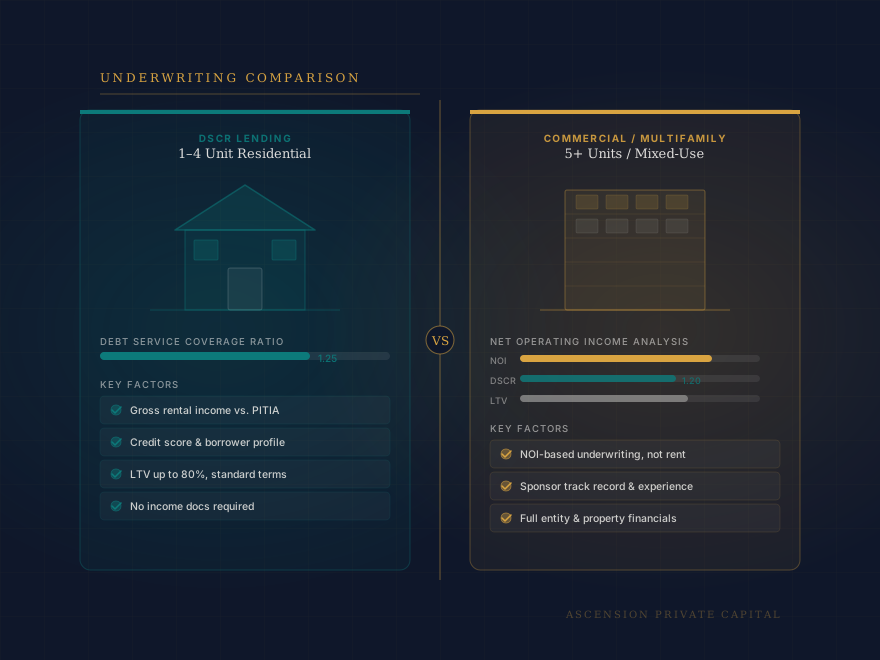
DSCR loans for 1–4 unit residential investment properties are designed to be relatively streamlined. The primary underwriting variable is the debt service coverage ratio — the relationship between the property's gross rental income and the monthly loan payment (including taxes, insurance, and any HOA).
In most cases, DSCR lenders evaluate:
- Gross rent relative to the proposed monthly debt service
- Property appraised value and loan-to-value ratio
- Borrower credit score (typically a minimum threshold)
- Cash reserves after closing
- Entity structure (LLC or individual)
The process is designed for speed and scalability. DSCR lenders typically do not require tax returns, W-2s, or detailed borrower income verification. The property qualifies itself — and the borrower simply needs to meet minimum credit and liquidity thresholds. For more on what DSCR lenders evaluate, see DSCR Loans: What Lenders Actually Look At.
02
How Commercial and Multifamily Underwriting Differs
When an asset crosses the 5+ unit threshold — or when it is a mixed-use, office, or commercial property — the underwriting approach changes significantly. Capital partners treat the property as a business, and the evaluation framework reflects that complexity.
Instead of gross rent, capital partners focus on net operating income (NOI) — total rental and ancillary income minus operating expenses. NOI drives loan sizing, debt coverage calculations, and valuation. The distinction matters: two properties with identical gross rent can have very different NOI based on management costs, maintenance, vacancy, and expense structure.
The underwriting conversation moves from "does the rent cover the payment?" to "does the asset generate enough net income to service debt, fund reserves, and maintain value?" That is a more involved question — and it requires significantly more documentation to answer.
03
Gross Rent vs. Net Operating Income
This is the single most important conceptual difference between residential DSCR underwriting and commercial underwriting.
DSCR (1–4 Units)
Lenders use gross scheduled rent (or actual rent from leases) compared against the full monthly debt service payment, including principal, interest, taxes, insurance, and HOA.
Operating expenses are generally not itemized in the underwriting. The assumption is that single-family and small multifamily properties have predictable, manageable expense loads.
Commercial / Multifamily (5+ Units)
Capital partners underwrite using NOI — gross income minus vacancy, management fees, repairs and maintenance, utilities, insurance, taxes, and other operating costs.
Every line item in the operating statement matters. High expense ratios, deferred maintenance, or unrealistic pro forma assumptions are underwriting risks that directly affect loan sizing.
Investors who have only worked with DSCR loans sometimes underestimate how much operating expenses affect the underwriting outcome on commercial deals. A property with strong gross rent but high expenses may not qualify for the leverage the investor expects.
04
Property-Level Operating History
DSCR lenders for 1–4 unit properties generally rely on an appraisal and a market rent analysis. The property's actual operating history is less critical because the expense structure is simple and predictable.
For commercial and multifamily assets, capital partners want to see how the property has actually performed over time. That means:
- Trailing 12-month (T12) income and expense statement
- Year-to-date financials for the current period
- Historical operating statements for 2–3 prior years when available
- Current rent roll with unit-level detail
- Occupancy trends and turnover history
Capital partners compare trailing performance against the investor's projections. Large gaps between actual performance and projected performance raise questions. The closer the pro forma is to trailing actuals — or the clearer the path from current performance to projected performance — the stronger the deal.
05
Sponsor Experience and Track Record
For DSCR loans on 1–4 unit properties, borrower experience is often a secondary consideration. Many DSCR programs accept first-time investors with adequate credit and liquidity. Track record may affect rate pricing but rarely determines whether a deal is approved.
In the commercial and multifamily space, sponsor experience is a primary underwriting variable. Capital partners want to know:
- Has the sponsor operated assets of similar size and type?
- Does the sponsor have a track record of successful executions?
- Has the sponsor navigated challenges — vacancy, renovation, lease-up?
- Does the sponsor have adequate liquidity beyond the closing capital?
- Is the management structure — self-managed or third-party — appropriate for the asset?
A deal with strong asset fundamentals can still stall if the sponsor does not have relevant experience. Capital partners may require more conservative terms, additional guarantors, or a co-sponsor with a stronger track record to mitigate execution risk.
06
Reserves and Liquidity Requirements
DSCR lenders typically require 3–12 months of payment reserves in liquid accounts after closing. The requirement is straightforward and based on the monthly payment amount.
Commercial capital partners often have more nuanced reserve expectations. Beyond debt service reserves, they may require:
- Operating reserves — capital set aside to fund ongoing expenses during lease-up or stabilization
- Capital expenditure reserves — funds earmarked for major repairs, roof replacement, or system upgrades
- Interest reserves — pre-funded interest payments for bridge loans where the asset is not yet producing sufficient income
- Completion reserves — holdbacks for renovation or construction projects, released upon milestone completion
These reserve structures protect the capital partner, but they also affect the investor's total capital requirement. Investors should factor reserves into their capital structure planning before assuming they can close with minimal out-of-pocket beyond the down payment.
07
Loan Sizing and Documentation Differences
DSCR loan sizing is relatively formulaic: the loan amount is the lesser of the maximum LTV (typically 75–80% for purchase) or the amount at which the DSCR ratio meets the lender's minimum threshold.
Commercial loan sizing involves multiple constraints evaluated simultaneously:
- Maximum loan-to-value (LTV) — typically more conservative than residential DSCR
- Minimum debt service coverage ratio — based on NOI, not gross rent
- Maximum debt yield — NOI divided by loan amount, used as a secondary constraint
- Loan-to-cost (LTC) — for construction and value-add scenarios
The most restrictive of these constraints determines the final loan amount. Investors accustomed to DSCR lending, where one ratio drives the outcome, sometimes find that commercial loan sizing is more conservative than expected — particularly when operating expenses are high or the asset is partially vacant.
08
When Investors Outgrow 1–4 Unit DSCR
The transition from residential DSCR lending to commercial capital is a natural part of scaling a real estate investment portfolio. Many investors start with single-family rentals and small multifamily, building experience and cash flow before moving into larger assets.
Common signals that an investor is ready to explore commercial and multifamily capital include:
- Targeting properties with 5 or more units
- Evaluating mixed-use or light commercial assets
- Considering value-add or repositioning strategies that require bridge capital
- Finding that DSCR programs do not accommodate the asset type or complexity
- Needing larger loan amounts beyond the typical residential lender ceiling
- Building a sponsor track record that supports institutional-quality financing
The transition does not need to happen all at once. Some investors maintain both 1–4 unit DSCR strategies and commercial assets simultaneously. The key is understanding that different capital partners serve each segment, and the documentation, evaluation, and timeline expectations differ significantly. Ascension Private Capital helps investors assess whether a deal fits the residential DSCR framework or requires commercial capital positioning.
Evaluating a Deal That May Need Commercial Capital?
Submit your scenario and we will review whether the deal fits residential DSCR, commercial, or a combination of capital sources — and help you prepare for the right approach.
Submit a Funding RequestRelated Insights
Continue exploring practical capital strategy, lender expectations, and funding structure insights.
DSCR Loans: What Lenders Actually Look At
A practical breakdown of how rental income, property value, reserves, credit, and borrower structure affect DSCR loan options.
Commercial Loan Document Checklist for 2026: What Investors Should Prepare
Documents investors should have ready before approaching capital partners for commercial or multifamily financing.
Commercial Real Estate Financing in 2026: What Investors Should Prepare For
How commercial real estate financing is being evaluated in 2026 — underwriting shifts, capital stack considerations, and deal positioning.
Ready to Discuss Your Deal?
Whether your deal fits DSCR, commercial capital, or a staged approach — we can help you identify the right path forward.
Submit a Funding Request