Strategic Applications
When Investors Use Gap Funding
Real-world scenarios where gap funding enables real estate investors to close deals, scale faster, and preserve capital for growth.
Strategic Timing for Gap Funding
Successful investors use gap funding strategically—not as a desperation move, but as a calculated tool to maximize leverage, preserve liquidity, and close deals that would otherwise require too much personal capital. Understanding when to deploy gap funding separates sophisticated investors from those who leave opportunities on the table.
Scenario 1: Multiple Simultaneous Acquisitions
Investors scaling their portfolios often encounter multiple attractive deals at once. Rather than passing on opportunities due to limited cash reserves, gap funding allows you to close on several properties simultaneously while preserving capital for subsequent deals.
Real Example
An investor identifies three properties in the same market, each requiring $75K in cash to close with their bridge lender. Rather than using $225K of personal capital, they deploy $75K on the first deal and use gap funding for the remaining $150K across the other two properties.
Result: All three deals close on schedule, cash remains available for unexpected costs, and the investor maintains capacity for additional acquisitions.
Scenario 2: Competitive Acquisition Environment
In hot markets, winning deals often requires offering above asking price or waiving financing contingencies. Gap funding provides the additional capital needed to submit stronger offers without overextending your cash position.
Market Dynamics
Multiple investors competing for quality inventory means you need to act fast and offer competitively. Gap funding provides flexibility to close quickly and offer above asking without derailing deal economics.
Speed Advantage
Gap funding approvals happen in 3-7 days. When sellers receive multiple offers, the ability to close quickly with minimal contingencies wins deals—even at slightly lower prices.
Scenario 3: Unexpected Renovation Overruns
Even experienced investors encounter unexpected costs during renovation. Hidden structural issues, code requirements, or supply chain delays can push budgets beyond initial estimates. Gap funding provides fast supplemental capital without disrupting existing financing.
Structural Discoveries
Foundation issues, roof replacement, or HVAC system failures discovered mid-project require immediate funding to keep renovations on track.
Permit & Code Compliance
Municipal requirements for electrical upgrades, plumbing work, or egress compliance can add significant unplanned costs that need immediate capital.
Scope Expansion
After starting work, you realize additional improvements will significantly increase ARV and rental income—gap funding enables value-add opportunities without renegotiating your primary loan.
Scenario 4: Capital Recycling Strategy
Sophisticated investors use gap funding to recycle capital quickly across multiple deals. By minimizing cash invested per property, you can deploy the same capital across more transactions, accelerating portfolio growth and improving overall returns.
Capital Efficiency Example
Without Gap Funding
$300K cash invested across 3 properties = 3 deals per year
With Gap Funding
$100K cash + $200K gap funding across 9 properties = 9 deals per year
Result: 3x deal volume with the same personal capital, dramatically accelerating portfolio growth and wealth building.
Scenario 5: Bridge to DSCR Exit Strategy
Investors using the bridge-to-DSCR strategy often need gap funding to maximize leverage during the acquisition and renovation phase. Once the property stabilizes, both the bridge loan and gap funding are paid off through the DSCR refinance.
Typical Structure
- Acquire property with bridge loan (75% LTC) + gap funding (15% LTC) + minimal cash (10% LTC)
- Complete renovations using combined bridge and gap capital
- Stabilize property with market-rate tenant
- Refinance into DSCR loan at 75-80% LTV based on improved ARV
- DSCR proceeds pay off bridge loan and gap funding simultaneously
- Investor extracts original cash investment plus profit from value-add
Scenario 6: Avoiding Equity Partner Dilution
Rather than bringing in equity partners who expect 30-50% of profits, gap funding provides the needed capital while preserving 100% ownership. This strategy works particularly well for deals with strong profit potential where the cost of gap funding is significantly less than equity dilution.
With Equity Partner (50/50)
- Project Profit: $150,000
- Partner Share: $75,000
- Your Net: $75,000
- Permanent dilution of ownership
With Gap Funding
- Project Profit: $150,000
- Gap Funding Cost: $25,000
- Your Net: $125,000
- 100% ownership retained
When Gap Funding Doesn't Make Sense
Gap funding is not appropriate for every situation. Avoid gap funding when deals have thin margins, weak exit strategies, or when you lack experience managing leveraged projects.
Situations to Avoid
- • Deals with minimal profit margin that can't absorb additional financing costs
- • Properties in declining markets with questionable exit strategies
- • First deal for inexperienced investors without proven execution ability
- • Projects where primary financing hasn't been secured or approved
- • Over-leveraged situations with insufficient equity cushion at completion
Strategic Decision Framework
Use gap funding when the value of capital preservation, deal velocity, or ownership control exceeds the cost of subordinated financing. Compare gap funding vs bringing more cash to determine the optimal structure for your situation.
- Does this deal generate sufficient profit to cover gap funding costs?
- Will preserving cash allow me to close additional deals?
- Is my exit strategy clear and achievable within the gap funding term?
- Does my experience level support managing a more leveraged project?
Free Download
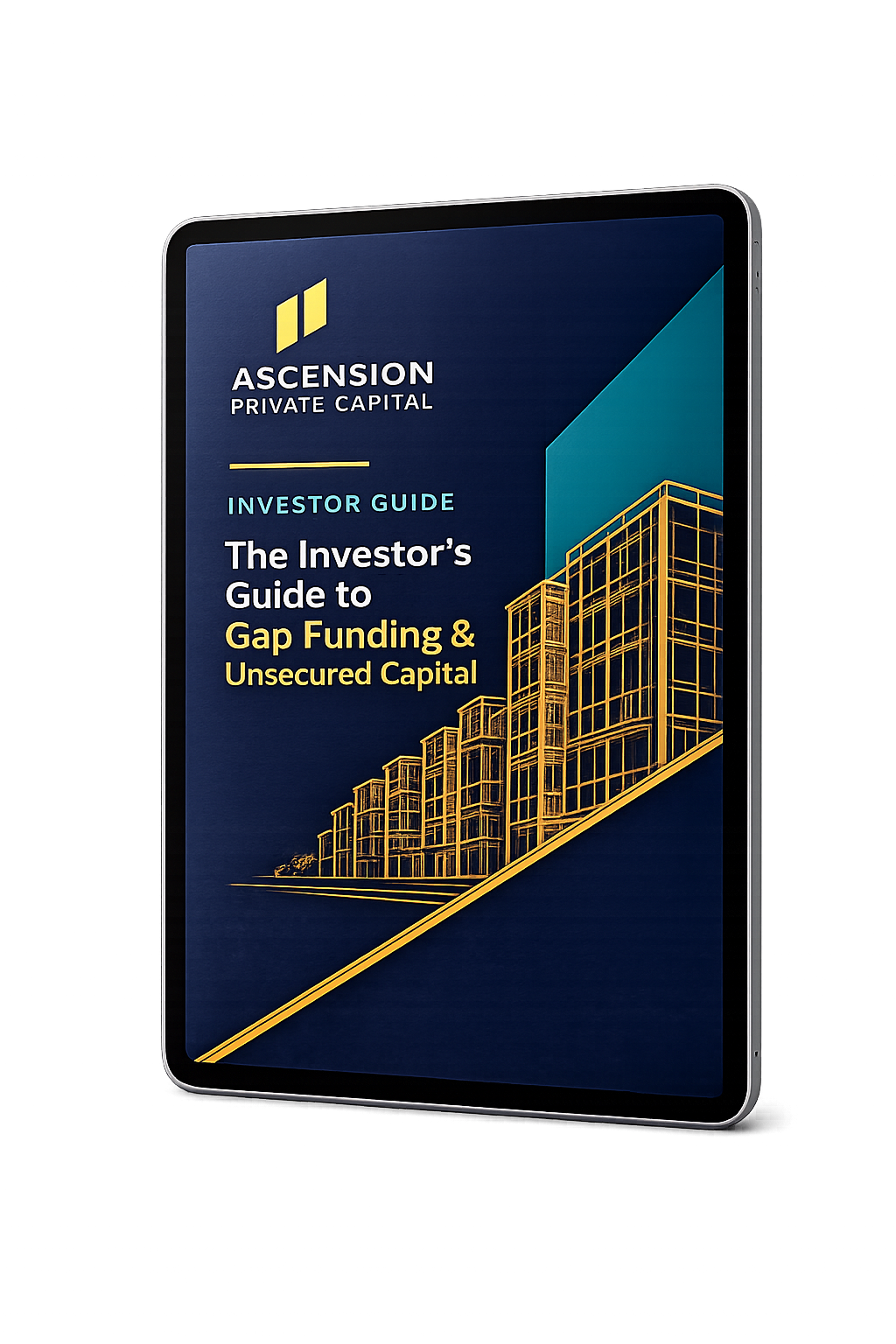
The Investor's Guide to
Gap Funding
Learn how investors solve down payment shortfalls, closing capital gaps, and funding mismatches with strategies like unsecured capital and cross-collateralization.
- Solve down payment shortfalls without depleting reserves
- Understand unsecured capital programs (FICO 680+)
- Learn when cross-collateralization makes sense
- See the decision framework for your exact situation
PDF Guide
The Investor's Guide to Gap Funding & Unsecured Capital
Get the Free Guide
Enter your details below to access the guide instantly.
Explore Gap Funding for Your Next Deal
Our team helps investors structure gap funding that maximizes leverage while maintaining strong deal economics and clear exit strategies.